LakesOnline Search Green Bay: 
      Home
US Flag U.S. Lakes Wisconsin Lakes Green Bay Home
Green Bay CommunityGreen Bay BoatingGreen Bay FishingGreen Bay MapsVisiting Green BayGreen Bay RentalsGreen Bay Real EstateGreen Bay Business DirectoryGreen Bay Site Index
Advertisement Advertise Your Business Here
 Green Bay, Wisconsin, USA - FishGizzard Shad
Gizzard Shad
Variant Names: Shad, Hickory Shad, Herring, Skipjack
Description:
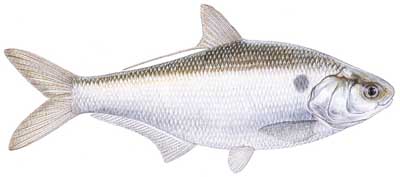
Dorosoma is Greek for "lance body," referring to the lance-like shape of young shad. The species epithet cepedianum refers to the French naturalist Citoyen Lacepede. Gizzard shad are usually easily distinguished from threadfin shad by the fact that the upper jaw projects well beyond the lower jaw. Amateur ichthyologists can run a finger underneath the mouth forward, and if the fingernail catches on the upper jaw and opens the mouth, in most cases the fish is a gizzard rather than a threadfin shad. The anal fin usually has 29-35 rays, as opposed to 20-25 rays found in threadfin shad. The upper surface is silvery blue, and grades to nearly white on the sides and belly. Fins do not have the yellowing tint present in threadfin shad. Unlike threadfin shad, the chin and floor of the mouth in this species is not speckled with black pigment.

Biology:
Gizzard shad are most abundant in large rivers and reservoirs, avoiding high gradient streams. The species is most often found in large schools. The common name "skipjack" is derived from the fact that individuals within a school may often be observed leaping out of the water or skipping along the surface on their sides. Spawning generally takes place in late spring, usually in shallow protected water. Eggs and milt are released in the school, seemingly without regard for individual mates. Adhesive eggs attach to submerged objects and hatch in about 4 days. Although adult shad are moderately deep-bodied, fry are extremely slender and delicate looking until they reach about 1.25 inches in length. Gizzard shad are planktivorous. Young feed on microscopic animals and plants, as well as small insect larvae. Adults feed by filtering small food items from the water using their long, close-set gill rakes. Although the species commonly grows to lengths of 9-14 inches, some have been reported to exceed 20 inches in l

   Lakes Online
Green Bay Community Green Bay Boating Green Bay Fishing Green Bay Maps Visiting Green Bay Green Bay Rentals Green Bay Real Estate Green Bay Business Directory Green Bay Site Index
Email this page to a friend Add To Favorites Search Green Bay Lakes Online You Tube Lakes Online Facebook The Lakemaster on Twitter Advertise With Us Advertise With Us Contact Webmaster
GreenBay.USLakes.info Privacy Policy